
Best Greyhound Betting Sites – Bet on Greyhounds in 2026
Loading...
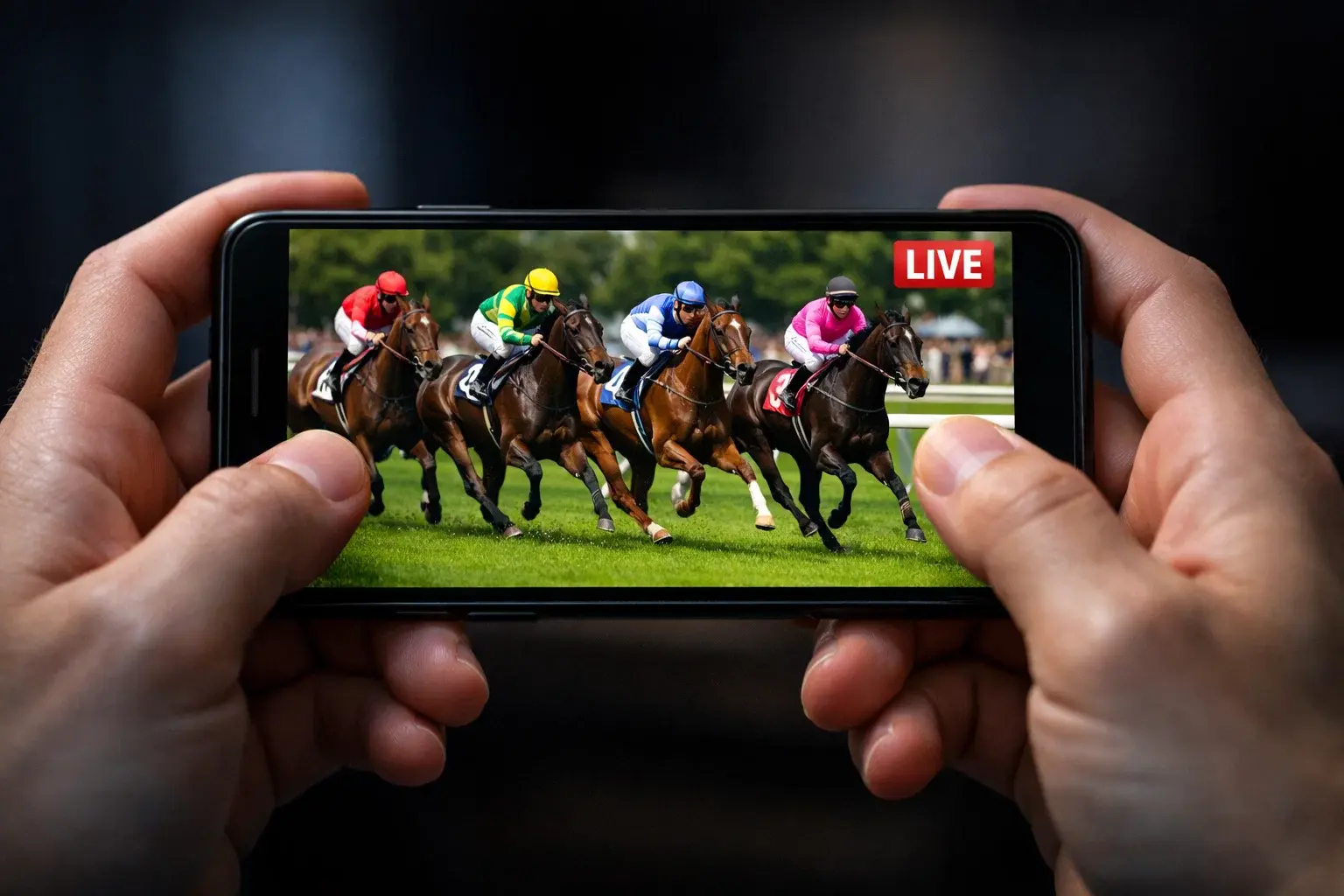
In-play horse racing betting compresses every analytical decision into the window between the stalls opening and the winning post. It is the most intense form of horse racing wagering — faster than football, less forgiving than tennis, and shaped by visual information that no algorithm can fully replicate. On non-GamStop sites, in-play markets operate under conditions that differ from domestic exchanges and UKGC-licensed bookmakers, and understanding those differences is essential before committing a single pound.
The scale of the market provides context. The Gambling Commission reported total remote sports betting gross gambling yield of £2.6 billion for the financial year ending March 2025, with horse racing accounting for £766.7 million of that figure. In-play markets represent a growing slice of that turnover, driven by the same mobile-first shift that has reshaped the broader betting industry. “The accessibility is now 24/7. They can target advertising to you that they know you will respond to,” noted Professor Heather Wardle of the University of Glasgow, lead researcher on the Lancet Public Health Commission on Gambling. In-play horse racing is the purest expression of that accessibility — bet as the race unfolds, with odds shifting in real time.
How In-Play Horse Racing Markets Work
In-play horse racing markets open the moment a race begins and remain active until the result is confirmed. The odds update continuously, reflecting each runner’s position and perceived chance as the race progresses. A horse leading by five lengths with two furlongs to run will be offered at significantly shorter odds than at the start; one trapped at the back of the field will drift rapidly.
On betting exchanges, in-play markets are peer-to-peer: bets are matched between users, and the odds reflect supply and demand in real time. On non-GamStop bookmaker sites, the operator manages the market directly, suspending and reopening it at critical moments — a fence in jump racing, the turn into the straight, the final furlong. The key difference is transparency: exchange odds reflect genuine market opinion, while bookmaker in-play odds reflect the operator’s risk management as much as the race itself.
The range of in-play bet types is narrower than for sports like football. Most platforms offer win markets only, sometimes extending to place markets on larger fields. The simplicity is a function of time: a race lasting two minutes does not support the granular market variety of a 90-minute football match. What it does support is rapid, dramatic price movement — and it is in those movements that the opportunity lies.
Cash-Out: Profit or Cut Losses Mid-Race
Cash-out is the headline in-play feature: the ability to settle a bet before the race finishes, locking in a partial profit or limiting a loss. Non-GamStop sites vary considerably in their implementation. Some offer full cash-out on every race, some restrict it to selected markets, and a few do not offer it at all for horse racing.
The logic is always the same. A horse backed at 10/1 ante-post is now trading at 3/1 with two fences to jump. Cashing out secures a guaranteed return; letting the bet run risks a fall or a fading effort in the closing stages. The rational decision depends on comparing the cash-out offer against the expected value of the remaining bet. If the horse has a 30 per cent chance of winning and the cash-out offers 70 per cent of the full potential return, taking the cash makes mathematical sense. If the offer is only 40 per cent, letting the bet ride is the sharper play.
What operators rarely advertise is that cash-out prices include a built-in margin. The offered amount is almost always less than the theoretical fair value of the bet’s remaining potential. That margin is the price of certainty, and recognising it prevents habitual cash-out use from slowly eroding expected returns.
In-Play Strategies for Horse Racing
The most effective in-play strategy in National Hunt racing is position-based betting during the middle phase of a long-distance chase. Over three miles or more, horses settle into positions during the first circuit, and the pace typically increases with a mile to run. A horse travelling well within the pack — still on the bridle, the jockey sitting motionless — often drifts in the in-play market because it is not visually prominent. When the rider asks for an effort and the horse quickens into contention, the odds shorten within seconds. The window between recognising that a horse is travelling strongly and the market catching up can be as narrow as five seconds — but that window is where the profit lives.
A complementary approach is laying horses that show early distress signals. In jump racing, a horse that fiddles its first two fences — jumping left, meeting them wrong, pecking on landing — is broadcasting its physical or mental state. Laying that horse at short in-play prices, before a fall or a pull-up, can produce consistent returns over a large sample, provided the bettor is watching the race and not simply reacting to price movements.
Both approaches require live viewing. In-play horse racing without watching the race is speculation, not strategy. The visual information — how a horse is jumping, whether the jockey is pushing or sitting, whether the horse is changing legs or showing signs of fatigue — is the only edge that speed of execution can convert into profit.
Latency and Fairness on Offshore Sites
Latency — the delay between events on the track and the bettor’s screen — is the central challenge of in-play horse racing on any platform. On domestic exchanges with direct data feeds, the delay is typically one to two seconds. On offshore non-GamStop sites, it may be three to five seconds, depending on the stream source and platform infrastructure.
That gap matters more in horse racing than in any other sport. A two-minute race means that a three-second delay represents roughly 2.5 per cent of the total event. During that lag, a leading horse can fall, a challenger can quicken, or the field can compress — and the bookmaker, using a faster data feed, has already adjusted the odds. The bettor placing an in-play wager on a delayed stream is, by definition, trading on stale information.
The practical countermeasure is to test the stream delay before betting in-play on any platform. Compare the live picture with a real-time text commentary or audio feed. If the visual delay exceeds two seconds, in-play betting on that platform carries a structural disadvantage that no skill can overcome. Some offshore operators mitigate this by suspending markets more frequently, but the underlying problem persists. For most punters on most non-GamStop platforms, the pre-race market remains the sharper and fairer arena.