
 Available in US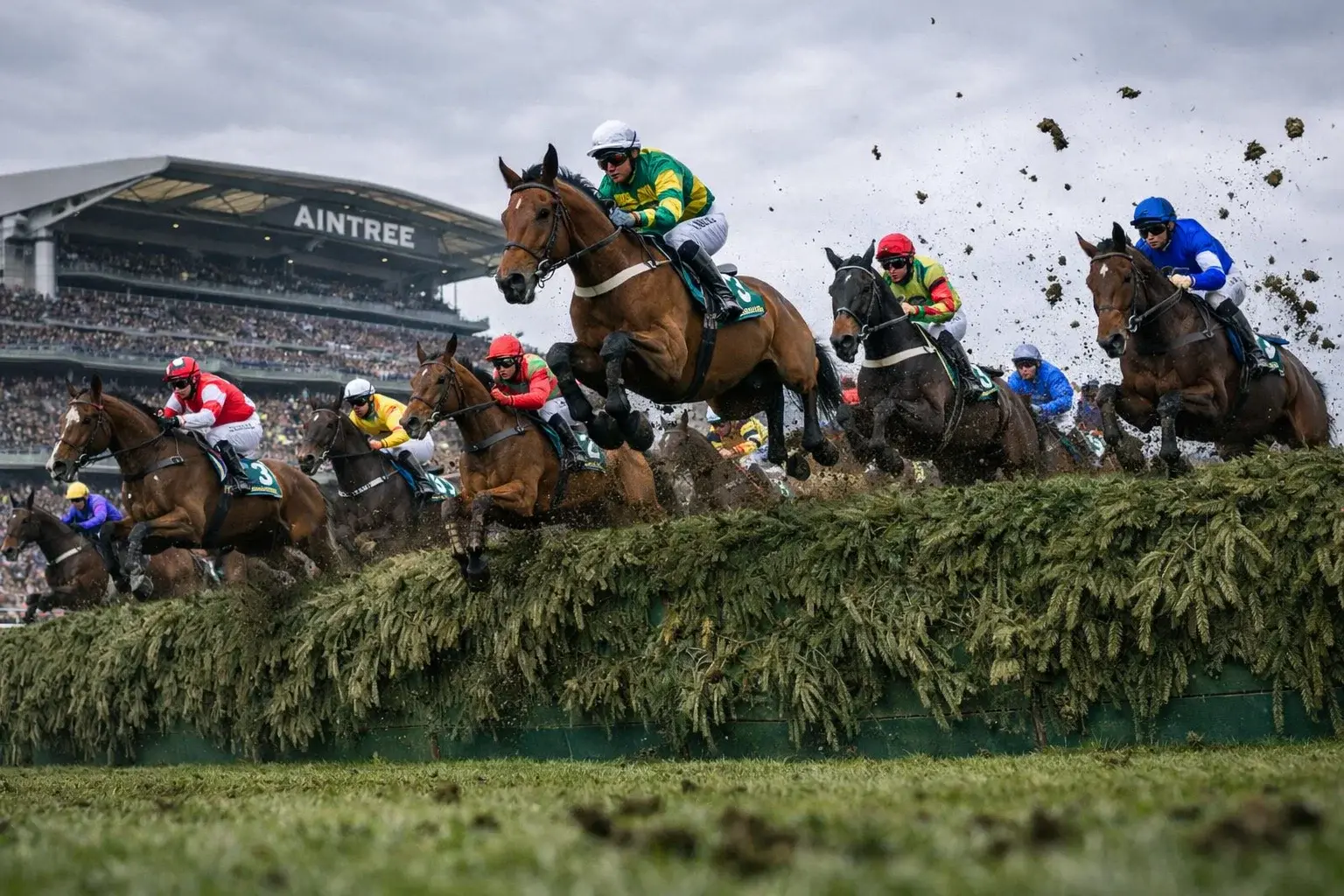
No single horse race defines British betting culture quite like the Grand National. It is the one day of the year when people who would never normally look at a race card pick a horse based on its name, its colours, or the advice of a colleague who claims to have “a feeling.” The race generates more individual bets than any other sporting event in the UK calendar, pulling in casual punters alongside seasoned form students in a way that no other race manages.
The horse racing industry in Britain is a substantial economic force — the British Horseracing Authority estimates direct revenues exceeding £1.47 billion, with a total economic contribution of £4.1 billion annually including induced effects. The Grand National sits at the commercial apex of that ecosystem, concentrating public attention and betting turnover into a single April Saturday.
For punters on GamStop, this creates a specific tension. The biggest betting event of the year arrives, and every UKGC-licensed bookmaker is off-limits. Non-GamStop bookmakers operating under offshore licences offer an alternative route to Aintree without limits — but that route comes with trade-offs in consumer protection, market depth, and promotional quality that are worth understanding before you back your first runner over those famous fences.
Race Format: 4 Miles, 30 Fences, the Unique Challenge
The Grand National covers four miles, two-and-a-half furlongs and includes thirty fences over two circuits of the Aintree course. It is the longest race in the British calendar at the highest level, and the obstacles are unique to the venue — spruce-topped fences that demand respect from even the most experienced chasers. Becher’s Brook, The Chair, and the Canal Turn are not marketing inventions. They are genuine tests that alter the complexion of the race every year.
The maximum field size is thirty-four runners, making it by far the largest field in top-class steeplechasing. That field size is central to the race’s betting appeal and its analytical difficulty. In a twelve-runner Gold Cup, you can realistically assess every horse’s form, fitness, and ground preference. In a thirty-four-runner Grand National, roughly half the field has a credible chance of completing the course, and perhaps ten or twelve have a realistic chance of finishing in the frame. The rest are there to test themselves against the fences and give their owners a story to tell.
Weights matter enormously. The Grand National is a handicap, meaning the official handicapper assigns each horse a weight designed to give every runner a theoretically equal chance of winning. In practice, top-weighted horses carrying eleven stone twelve carry a genuine burden over four miles and thirty fences. The historical record strongly favours horses carrying between ten stone and eleven stone, running off marks between 140 and 155. This is not a trivial detail — it is the single most predictive data point for narrowing down a thirty-four-horse field to a manageable shortlist.
The going conditions add another variable. Aintree’s drainage has improved significantly over the decades, but heavy ground still transforms the race from a test of speed and jumping into a war of attrition. Horses who stay the trip on good ground may not get home when the ground turns soft, and vice versa. Checking the going forecast in the days before the race is not optional for anyone planning a serious Grand National bet.
Betting Markets for the Grand National
The core market is win and each-way, and for the Grand National, each-way betting is where most of the value resides. Standard UKGC terms pay four places at one-quarter the odds. Several non-GamStop bookmakers extend this to five or even six places for the National, which — given the forty-runner field — represents a meaningful improvement in expected value. If your selection finishes fifth at 25/1, the difference between a void place bet and a payout at 6/1 (quarter odds) is not trivial.
Ante-post markets for the Grand National open months in advance, and the prices can be significantly better than what is available on the day. The trade-off is the non-runner, no refund rule: if your horse does not line up, the stake is gone. In a race where late withdrawals due to ground conditions or veterinary assessments are common, this risk is real. The general principle is that ante-post value is greatest for horses with versatile ground preferences and trainers with a strong record of getting horses to Aintree in one piece.
Beyond win and each-way, the Grand National supports a range of novelty and derivative markets. Betting without the favourite removes the market leader and adjusts the field, which can be useful when the favourite is a short-priced horse with obvious vulnerability over the extreme distance. First to fall, last to finish, and distances between finishers are all available on the larger non-GamStop platforms. Forecast and tricast betting — predicting the first two or three home in the correct order — is high-risk, high-reward, and the sheer field size means the returns on a correct forecast can be spectacular.
Non-GamStop sites vary considerably in their Grand National market depth. The better offshore operators will offer everything mentioned above, plus top jockey and top trainer markets. Smaller sites may only price up win and each-way on the day itself, with no ante-post book and no special markets. If Grand National betting is your primary reason for using a non-GamStop platform, checking the market range before registering saves time and disappointment.
Grand National History and Iconic Moments
The Grand National has been run since 1839, making it one of the oldest steeplechases in the world. Its longevity alone does not explain its cultural grip — what sets it apart is the sheer volume of improbable stories the race has produced. Red Rum’s third victory in 1977, achieved at the age of twelve after two previous wins and two second places, remains perhaps the most famous result in British racing history. The horse became a national institution, and his trainer Ginger McCain became a household name.
The 1967 race provided what many consider the most chaotic finish the sport has ever seen. A massive pile-up at the twenty-third fence left only one horse standing — Foinavon, a 100/1 outsider who was so far behind the leaders that his jockey had time to navigate around the carnage. He won by fifteen lengths. The fence was renamed in his honour, and his victory remains shorthand for the glorious unpredictability that makes the race unmissable for bettors.
More recent history has its own moments. Tiger Roll’s back-to-back victories in 2018 and 2019 — the first horse to win consecutive Nationals since Red Rum — demonstrated that class can override the race’s inherent chaos, at least occasionally. The cancellations of 1993 (a false start that was never recalled) and the pandemic-enforced void of 2020 showed the other side: even the Grand National is not immune to farce and circumstance.
For bettors, the historical record offers genuine analytical value. Certain trainer-jockey combinations thrive at Aintree. Horses with previous course experience over the National fences have a statistically better completion rate. The weight range that produces winners has remained remarkably consistent for decades. History does not predict the future, but in a race this old and this well-documented, it narrows the field more reliably than instinct alone.
The GamStop Spike: Why Aintree Drives Self-Exclusion Records
The connection between the Grand National and problem gambling is not anecdotal — it is documented in GamStop’s own data. Monday 7 April 2025, two days after that year’s Grand National, became the single busiest day in GamStop’s history with 437 self-exclusion registrations. The timing is not coincidental. The Grand National draws millions of occasional bettors into the market, many of whom discover — over the course of a single Saturday afternoon — that they have spent more than they intended, chased losses they should have accepted, or felt a compulsion that caught them off guard.
The pattern repeats annually, though the 2025 spike was the most extreme example on record. Major racing events act as triggers because they combine several risk factors simultaneously: widespread social encouragement to bet, extensive media coverage that normalises wagering, easy access to multiple betting markets, and the emotional intensity of a race that genuinely grips the nation. For someone already on the edge of problematic gambling behaviour, the Grand National can be the event that pushes them over.
This matters directly for anyone considering using a non-GamStop bookmaker to bet on the race. If you signed up for GamStop for a reason, the Grand National is precisely the kind of event that tests the original motivation behind that decision. The excitement is real, the desire to participate is understandable, but the absence of UKGC-mandated protections on offshore sites means you are betting without a safety net during the most emotionally charged racing event of the year.
None of this means that every Grand National bet placed on a non-GamStop site leads to harm. Plenty of people will back a horse, enjoy the race, and move on. But the data shows clearly that this particular event has a measurable impact on gambling behaviour at a population level. Knowing that before you place your bet is not scaremongering — it is information that helps you make a more honest assessment of your own relationship with risk.
