
Best Greyhound Betting Sites – Bet on Greyhounds in 2026
Loading...
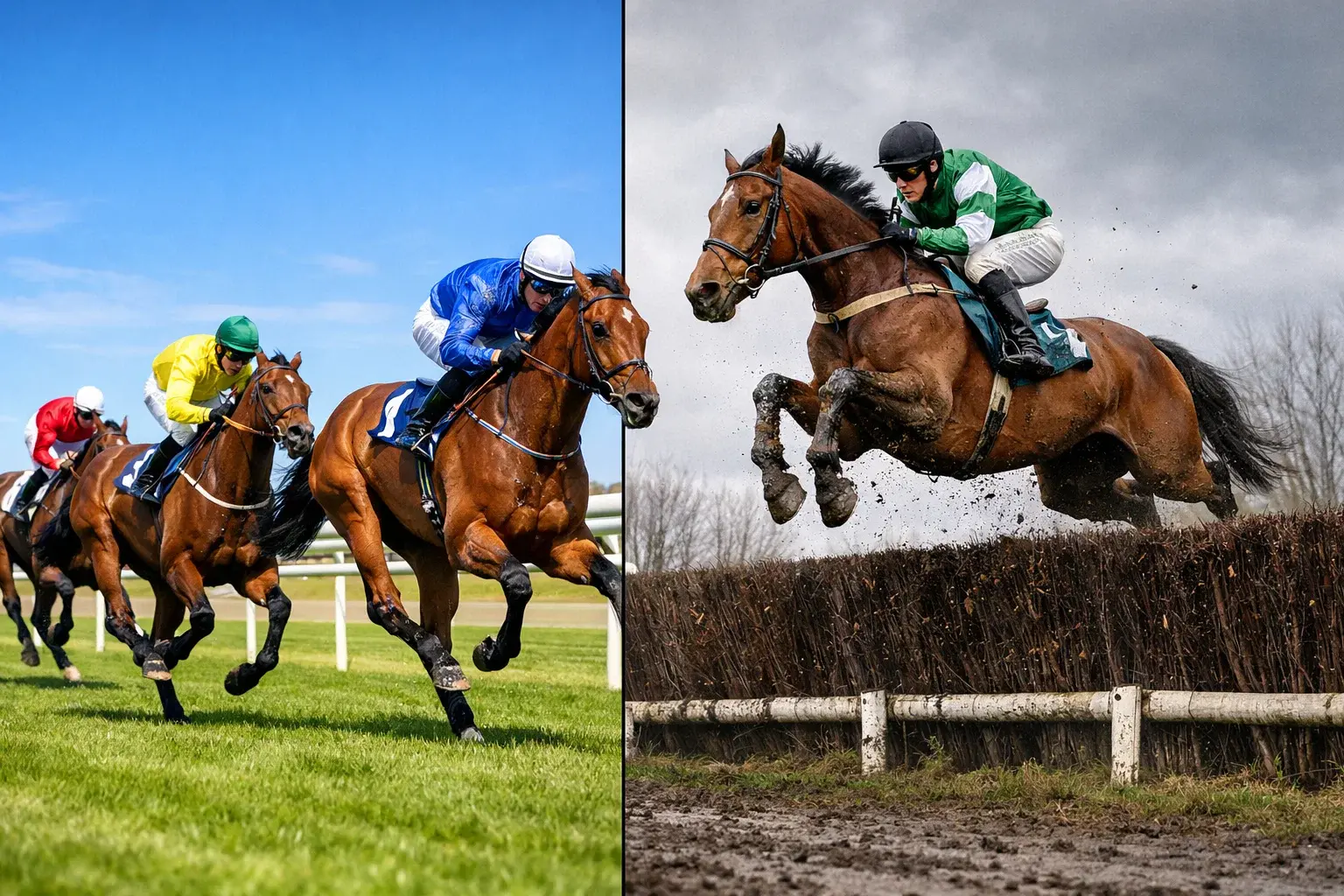
British horse racing is not one sport. It is two disciplines that share a species, a betting infrastructure, and a regulatory framework — and very little else. Flat racing and jump racing differ in season, surface conditions, distance range, athletic demands, and the analytical approach required to bet on them profitably. The distinction matters. A punter who treats the two codes as interchangeable is making the same mistake as someone who assumes a tennis strategy works for badminton because both involve a net.
The economic footprint of both disciplines combined is substantial. According to data presented by the British Horseracing Authority to Parliament, the racing industry generates direct revenues exceeding £1.47 billion and makes a total annual economic contribution of £4.1 billion, supporting over 85,000 jobs. In the first half of 2024 alone, more than 2.3 million people attended British racecourses. Those visitors split — often fiercely — between followers of the flat and devotees of the jumps, and the two disciplines offer meaningfully different betting propositions.
Flat Racing: Speed, Turf, and the Classic Season
Flat racing is the older and, globally, the more commercially powerful branch. Horses run on level ground with no obstacles, over distances that range from five furlongs — about 1,000 metres, over in barely a minute — to two miles and six furlongs. The primary turf season runs from April to October, though all-weather fixtures at Lingfield, Wolverhampton, Newcastle, Kempton, and Chelmsford extend the calendar through the winter months on synthetic surfaces.
Speed is the defining currency. In sprint races, the margin between first and last can be less than three lengths despite a field of fifteen. Positional advantages from the draw — the stall number each horse breaks from — can be decisive at certain courses. Chester, with its tight left-handed loop, is the classic example: a low draw over five or six furlongs gives a rail position into the bend that is almost impossible to overcome from a wide berth. At straighter courses like Ascot’s mile, the draw effect diminishes. Knowing which courses carry draw biases, and at which distances, is a prerequisite for serious flat betting.
The prestige events define the flat calendar: the five British Classics (2000 Guineas, 1000 Guineas, Derby, Oaks, St Leger), five days of Royal Ascot in June, the Ebor Festival at York in August, and Glorious Goodwood in late July. These fixtures attract international runners, deep market liquidity, and sharp pricing. The larger-field handicaps at these meetings — the Royal Hunt Cup, the Stewards’ Cup, the Ebor itself — are where the less-followed horses drift to prices that sometimes overstate their true chances, creating opportunity for form students.
Breeding information is transparent and heavily referenced in flat racing. Sire lines give strong indications of distance aptitude and ground preference, and the market often prices maiden and novice runners partly on pedigree rather than racecourse evidence. When actual form data conflicts with breeding expectation, the resulting price discrepancy can represent genuine value.
Jump Racing: Fences, Endurance, and the Winter Calendar
Jump racing — officially National Hunt racing — runs primarily between October and April, with a scattering of summer fixtures at smaller tracks like Market Rasen and Cartmel. Horses compete over obstacles that come in two varieties: hurdles, which stand at roughly 3 feet 6 inches and are designed to brush through on impact, and steeplechase fences, which rise to 4 feet 7 inches and are substantially stiffer. Distances start at two miles for hurdle races and extend well beyond three miles for many chases, with the Grand National at Aintree covering four miles and two-and-a-half furlongs over 30 fences.
The atmosphere is different from the flat. Jump racing is a winter sport, shaped by mud, rain, and the physical toll of repeated jumping. Ground conditions — officially described from firm through good to soft and heavy — have a more dramatic effect on results than in flat racing. A horse that glides over good ground may struggle in heavy going, where every stride requires measurably more effort. Checking the going report before placing a bet is not optional; it is the first thing any informed jump racing punter does.
Jumping ability adds a dimension of risk that flat racing simply does not have. A horse can be the best on form and fall at the second fence. In competitive handicap chases, completion rates can dip below 70 per cent. This attrition reshapes the betting mathematics: each-way wagers become more attractive because non-completions widen the effective place frame. A horse finishing third in a 16-runner handicap chase has likely beaten a dozen rivals that either fell, unseated, or pulled up — a context that pure finishing position does not capture.
The championship fixtures of the jump season are concentrated into the Cheltenham Festival in March — four days, 28 races, headlined by the Champion Hurdle, Champion Chase, and Gold Cup — and the Aintree Grand National meeting in April. Ante-post markets for Cheltenham open months ahead and produce significant turnover, particularly in the Gold Cup, where early prices regularly offer more value than the day-of-race market.
Key Differences at a Glance
Season is the most visible dividing line: flat racing occupies the warmer months, jump racing the colder ones, with overlap at the margins. Distance ranges differ sharply — the longest flat races are shorter than the shortest steeplechases. Obstacles are exclusive to jump racing and introduce a binary risk (complete the course or not) that flat racing lacks entirely. Ground conditions affect both codes but exert a stronger influence over jump racing results, partly because the distances are longer and partly because winter ground varies more dramatically within a single meeting.
Prize money at the top end is higher in flat racing. A Group 1 at Royal Ascot or the Derby carries purses that dwarf most National Hunt equivalents, though the Cheltenham Gold Cup and King George are well-funded. For bettors, the practical implication is that the quality gap in jump racing is more compressed: surprise results at double-figure odds happen more frequently than in a six-runner Group 1 flat race where two horses dominate the market.
Form reliability also diverges. Flat form is generally more stable because the main variables — speed, distance aptitude, class — are consistent across runs. Jump form carries more noise: obstacles, going shifts, and the physical demands of longer races produce form reversals that would be unusual on the flat. A horse returning from a fall may jump tentatively next time, altering its run style in ways the form figures do not explicitly capture.
Which Suits Your Betting Style?
Flat racing rewards punters who enjoy working with data — speed figures, sectional times, draw statistics, trainer patterns by course type. It suits an analytical temperament that can tolerate tight margins and results where a nose separates the first five. The handicap sprint divisions are particularly fertile for form students, because the large fields and compressed quality levels mean the market cannot price every runner accurately.
Jump racing rewards a different skill set: the ability to watch a horse jump, to read how it travels through a race, and to assess fitness and wellbeing from visual cues that no spreadsheet captures. It suits bettors who watch replays, who remember that a particular horse jumped left at Sandown last time, and who understand that three miles in heavy ground is a test of character as much as ability. The each-way market in jump racing is the natural hunting ground for this type of punter, because non-completions create place value that the headline odds understate.
Most experienced UK bettors operate across both codes, adjusting their focus with the calendar. The two disciplines are complementary halves of a year-round betting landscape — and the punters who understand both have twice the opportunity to find value where the market gets it wrong.