Best Greyhound Betting Sites – Bet on Greyhounds in 2026
Loading...
Best Odds Guaranteed is one of those features you do not think about until it is gone. On a UKGC-licensed bookmaker, BOG is so standard that most punters take it for granted — back a horse at 8/1 in the morning, watch the SP drift to 12/1 by post time, and the bookmaker pays you at the bigger price. It costs the bookmaker money and it protects the bettor from price movements. It is, by any measure, one of the best deals in horse racing betting.
On non-GamStop sites, BOG is largely absent. The price protection offshore that UKGC punters are accustomed to does not translate to the offshore market for reasons that are partly structural and partly economic. Understanding why — and what alternatives exist — is important for anyone who has moved their horse racing betting to a non-GamStop platform and noticed that their returns no longer include the automatic price safety net.
Better odds and prices rank as a significant motivation for using non-GamStop operators. According to Frontier Economics data, 29.6% of users on unregulated betting platforms cited better odds as a reason for their choice. Yet the absence of BOG means that the “better odds” claim deserves scrutiny — because the odds you see at 10am are not necessarily the odds you receive at 3pm, and without BOG, any SP drift works against you rather than for you.
How Best Odds Guaranteed Works on UKGC Sites
BOG works on a simple principle: if you take an early price on a horse and the starting price is higher, the bookmaker pays you at the SP instead. If the SP is lower, you keep your original price. Heads you win, tails you do not lose.
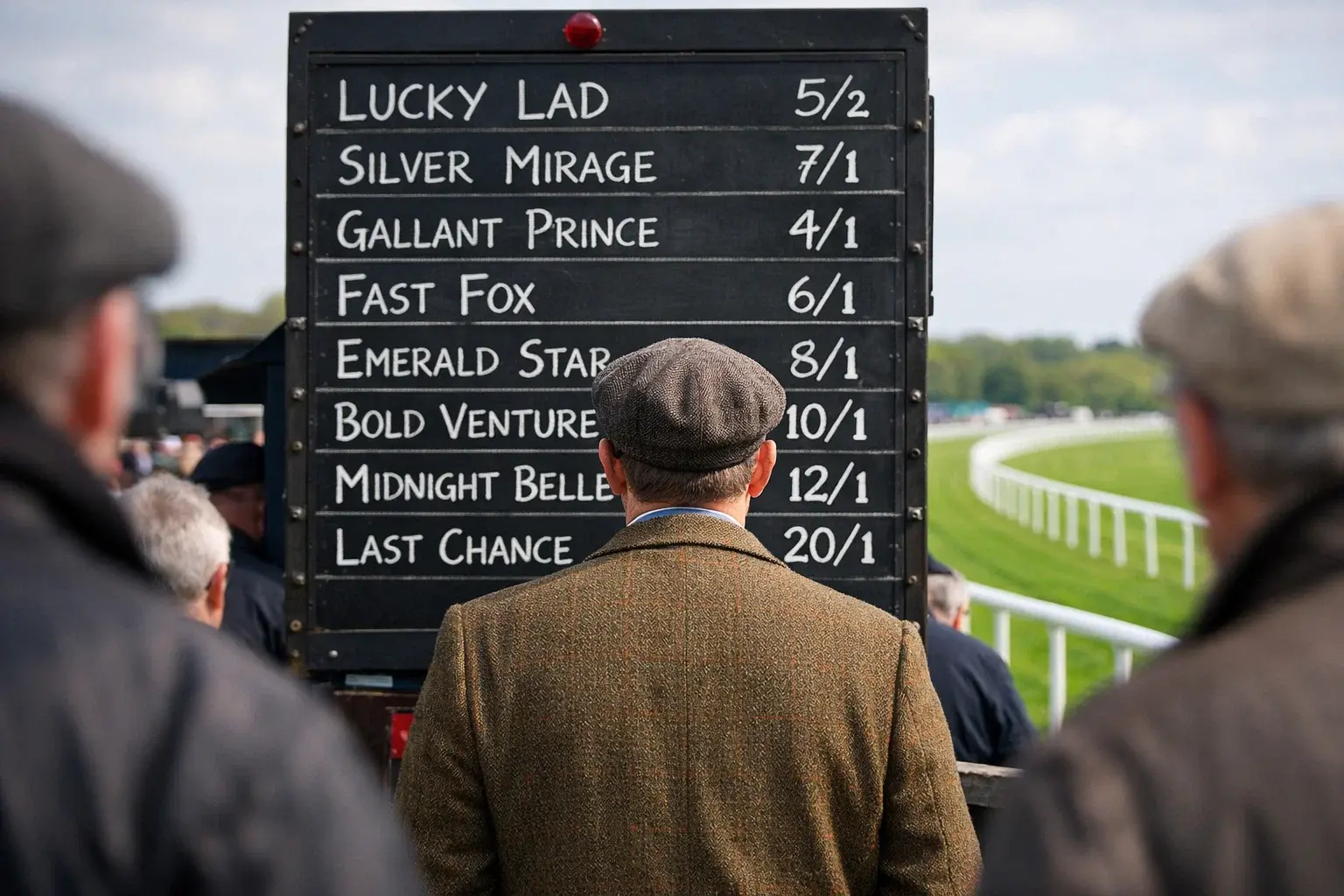
In practical terms, this covers one of the most common scenarios in horse racing betting. You study the form in the morning, identify a horse you like, and back it at the price available. Throughout the day, money flows into the market — on-course bookmakers adjust their boards, exchange prices fluctuate, and the official SP at the off may be significantly different from the price you took hours earlier. Without BOG, if the SP drifts from 8/1 to 12/1, you are stuck with your 8/1. With BOG, you receive 12/1.
The economics of BOG are absorbed by the bookmaker as a cost of customer acquisition and retention. On average, BOG costs a UKGC bookmaker a small percentage of their horse racing GGY — it is a real expense, but one that is offset by the volume of bets it attracts and the customer loyalty it generates. For the UK horse racing industry, the effective levy rate stands at 8.5% of GGY, according to Plumpton Racecourse’s analysis of Gambling Commission data. BOG is one of the features that keeps betting volume — and therefore levy contributions — flowing through regulated channels.
BOG typically applies to win and each-way bets placed on UK and Irish horse racing on the day of the race. It does not usually extend to ante-post bets, bets placed in-play, or bets on international racing. These limitations are consistent across UKGC sites and are clearly stated in the terms — a level of transparency that sets the benchmark for what price protection should look like.
The BOG Gap: Why Most Non-GamStop Sites Don’t Offer It
The absence of BOG on most non-GamStop sites comes down to a combination of margin pressure and market structure.
Offshore bookmakers typically operate on thinner margins than their UKGC counterparts. They do not pay UK point-of-consumption tax, but they also have smaller customer bases, higher acquisition costs per bettor, and less diversified revenue streams. BOG is an open-ended liability — the bookmaker cannot predict in advance how much it will cost on any given day, because the cost depends on how many prices drift between the morning market and the SP. For a smaller operator, this unpredictability represents a financial risk that many are unwilling to absorb.
Market structure plays a role too. BOG depends on the concept of a reliable Starting Price — an officially calculated price at the off, derived from on-course bookmaker boards. The SP is a distinctly British institution, administered by the Starting Price Regulatory Commission, and it provides a transparent benchmark that BOG can reference. Offshore bookmakers, particularly those primarily serving international markets, are less integrated with this system. Their odds may track the exchanges or their own book rather than the SP, making a BOG-style guarantee mechanically awkward to implement.
There are exceptions. A small number of non-GamStop bookmakers do offer BOG or a close equivalent on selected UK racing. These tend to be the larger, more established offshore operators who compete directly with UKGC sites for UK racing bettors. If BOG is important to your betting strategy — and for anyone who bets on morning prices regularly, it should be — identifying these operators is worth the research time. But treat “BOG available” claims on affiliate sites with scepticism until you confirm it directly in the bookmaker’s promotional terms.
As Grainne Hurst, CEO of the Betting and Gaming Council, has pointed out, millions of customers are being driven toward unregulated operators — and the absence of features like BOG is one of the concrete trade-offs they encounter. The better odds headline that attracts bettors offshore does not always account for the price protection they leave behind.
Alternatives: Odds Boosts, Enhanced Prices, Price Promise
Where BOG is absent, non-GamStop bookmakers sometimes offer alternative promotions that partially fill the gap. None of these are direct replacements, but understanding what is available can help you extract more value from a market that does not offer the automatic price protection you may be used to.
Odds boosts are the most common substitute. These are enhanced prices on selected runners in feature races — a horse priced at 6/1 in the general market offered at 8/1 as a promotional special, usually with a maximum stake. The boost is a fixed enhancement at the point of the bet, not a guarantee tied to SP movement. It gives you a better price than the market, but it does not protect you if the price continues to drift after you have taken the boost. Think of it as a one-off bonus rather than a systemic protection.
Enhanced prices work similarly but are typically applied to accumulators or multi-bet offers rather than individual race selections. An offshore bookmaker might offer a 10% enhancement on any horse racing accumulator of three or more legs, paid as bonus credit. The value here depends on the terms — if the enhancement pays as cash, it adds genuine value; if it pays as bonus credit with wagering requirements, the real benefit is diluted.
Price promise schemes appear on a few non-GamStop platforms. These typically guarantee that the odds on offer match or beat one specific competitor’s prices on selected markets. The comparison is usually drawn against a major UKGC bookmaker’s morning prices, and the promise applies to a limited number of races per day. It is a partial substitute for BOG, but it requires you to check the comparison prices manually and it only covers the subset of races the operator selects.
None of these alternatives replicate what BOG provides: an automatic, blanket guarantee that you will always receive the best of your price or the SP, with no action required on your part. They are marketing tools rather than structural protections, and they should be evaluated on their specific terms rather than assumed to be equivalent.
Odds Shopping as a Manual BOG Replacement
If BOG is not available, the closest manual equivalent is odds shopping — comparing prices across multiple bookmakers and taking the best available price at the time you bet. It requires more effort than BOG, which works automatically, but it can produce similar or even better results if done consistently.
The approach is straightforward. Before placing a bet on a specific race, check the odds on two or three non-GamStop sites alongside at least one exchange or odds comparison service. Odds comparison tools aggregate prices from multiple bookmakers in real time and highlight which platform is offering the best value on each runner. If one site has your selection at 10/1 and another at 12/1, the extra two points of value are equivalent to a BOG payout on a price drift — except you have identified it yourself rather than relying on an automatic mechanism.
The discipline required is the main barrier. Odds shopping takes time, and the temptation to just place the bet at the price in front of you is real, especially during a busy afternoon card. Building a habit of checking at least two prices before confirming a bet is a simple rule that compounding data suggests makes a measurable difference to long-term returns.
There is an additional benefit to holding accounts with multiple non-GamStop bookmakers for odds-shopping purposes: it distributes your risk. If one platform encounters withdrawal issues or goes offline, your entire bankroll is not locked in one place. Spreading your activity across three or four reputable offshore operators gives you price flexibility and reduces single-operator exposure.
BOG remains the gold standard for price protection in horse racing. Its absence on non-GamStop sites is a genuine disadvantage, and no amount of odds shopping fully replicates its automatic, zero-effort guarantee. But for bettors who are willing to invest five extra minutes per bet, comparing prices across platforms is the most effective way to mitigate the gap — and in a market where every point of value counts, that effort pays for itself.