
 Available in US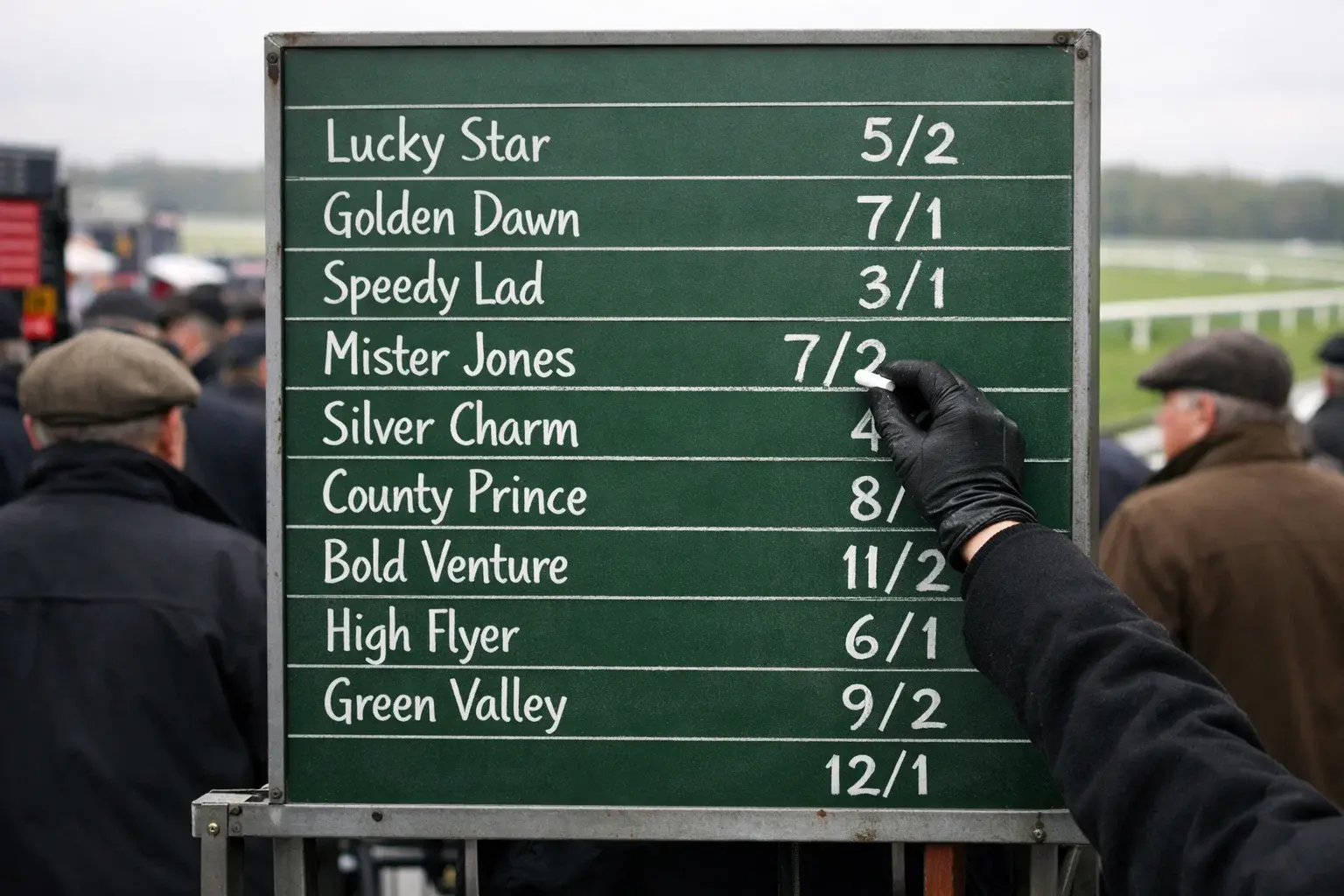
Analyzing Value Margins at Offshore Racing Bookmakers
One of the most frequently cited reasons for using non-GamStop horse racing sites is the promise of better odds. And in many cases, the claim has substance. Offshore bookmakers operating outside the UKGC framework face lower regulatory costs, fewer compliance overheads, and less tax burden — all of which can translate into tighter margins and, consequently, more competitive prices for the bettor. But “can” and “always do” are different propositions, and the odds landscape across non-GamStop platforms is far less uniform than marketing copy suggests.
According to the Frontier Economics survey for the Betting and Gaming Council, better odds and more flexible payment methods were each cited by 29.6% of respondents as reasons for using unregulated operators — making competitive pricing the fourth most common motivation after better bonuses (34.5%), ease of registration (32.3%), and anonymity (30.9%) (S16). The data confirms that a meaningful segment of the offshore audience is actively shopping for price — not merely for access.
The broader betting market provides important context. Total GGY from remote (online) betting across all sports reached £2.6 billion in FY2024–25, a 10.9% year-on-year increase, according to the Gambling Commission (S11). Horse racing accounted for £766.7 million of that total — the second-largest sport after football’s £1.3 billion. Grainne Hurst, CEO of the Betting and Gaming Council, has warned that regulatory cost pressures are reshaping the competitive landscape: “These are not theoretical risks; they reflect the realities of a digital market where consumers can switch provider instantly” (BGC, December 2025) (Q04). That instant-switching dynamic is precisely what makes odds comparison between UKGC and non-GamStop sites commercially significant.
The scale of the horse racing betting market means that even marginal improvements in odds — a few percentage points of margin reduction — aggregate into meaningful differences for regular bettors over the course of a season.
This guide breaks down how odds work, what determines a bookmaker’s margin, how to compare prices across non-GamStop platforms, and — critically — when better odds do not necessarily translate into better value.
Odds Formats: Fractional, Decimal, and American
Before comparing odds across sites, it is essential to understand the three formats in which they are expressed — and to be able to convert between them fluently, because non-GamStop bookmakers do not always default to the fractional format familiar to UK punters.
Fractional odds
The traditional format for UK horse racing. Expressed as a fraction — 5/1, 11/4, 6/4 — where the first number represents the profit and the second represents the stake. A £10 bet at 5/1 returns £50 in profit plus the £10 stake = £60 total. Fractional odds are intuitive for UK bettors but awkward for precise comparison: is 11/4 better or worse than 13/5? (11/4 = 2.75 profit per unit staked; 13/5 = 2.60. So 11/4 is marginally better — but spotting that instantly in fractional form requires mental arithmetic.) These comparisons are easier in decimal form.
Decimal odds
The global standard and the default on most non-GamStop sites. Expressed as a single number — 6.00, 3.75, 2.50 — representing the total return per unit staked, including the stake itself. A £10 bet at 6.00 returns £60 total (£50 profit + £10 stake). Decimal odds make comparison instant: 6.00 is better than 5.80; 3.75 is better than 3.50. No mental arithmetic required.
American odds
Used primarily by US-facing sportsbooks and occasionally by non-GamStop sites with an international clientele. Positive numbers (+500) indicate the profit on a $100 stake; negative numbers (−150) indicate the stake needed to win $100. A +500 line is equivalent to 5/1 fractional or 6.00 decimal. A −150 line means you need to stake £150 to win £100 — equivalent to 2/3 fractional or 1.67 decimal. Most UK-focused non-GamStop sites allow you to switch display format in your account settings; if they don’t, familiarise yourself with decimal odds, which are universally readable.
| Fractional | Decimal | American | Implied Probability |
|---|---|---|---|
| 1/5 | 1.20 | −500 | 83.3% |
| 1/2 | 1.50 | −200 | 66.7% |
| Evens (1/1) | 2.00 | +100 | 50.0% |
| 2/1 | 3.00 | +200 | 33.3% |
| 5/1 | 6.00 | +500 | 16.7% |
| 10/1 | 11.00 | +1000 | 9.1% |
| 33/1 | 34.00 | +3300 | 2.9% |
The implied probability column is the key analytical tool. It tells you what percentage chance the bookmaker’s odds assign to a horse winning. If your own assessment — based on form, going, draw, and race conditions — gives a horse a 25% chance of winning, and the bookmaker’s odds imply only a 20% chance (5/1), the bet has positive expected value. This is the foundation of value betting, and it works identically whether you are betting on a UKGC site or a non-GamStop platform.
What Determines a Bookmaker’s Margin?
The bookmaker’s margin — also called the overround, vig, or juice — is the mathematical edge built into a set of odds. It represents the difference between what the bookmaker pays out in a perfectly balanced book and what it collects. Understanding margin is the single most important skill for bettors who want to maximise long-term returns, because margin is the structural cost of every bet you place.
How overround works
In a theoretically fair market, the implied probabilities of all runners would sum to exactly 100%. In reality, they always sum to more than 100%. The excess is the bookmaker’s margin. For example, in a three-horse race where the true probabilities are 50%, 30%, and 20%, a fair-odds market would price them at 2.00, 3.33, and 5.00 (summing to exactly 100%). A bookmaker might instead price them at 1.90, 3.10, and 4.50 — implied probabilities of 52.6%, 32.3%, and 22.2%, summing to 107.1%. That 7.1% overround is the bookmaker’s margin.
UKGC operator margins on horse racing
Major UKGC-licensed bookmakers (Bet365, William Hill, Ladbrokes, Betfair Sportsbook) typically operate with overrounds of 110% to 118% on UK horse racing, depending on the quality and competitiveness of the race. Feature races at festivals (the Gold Cup, the Derby, the Champion Hurdle) attract the tightest margins — sometimes as low as 105%–108% — because these events generate the highest betting volumes and operators compete aggressively on price. Midweek all-weather handicaps at Wolverhampton, by contrast, may carry overrounds of 120%+ because volumes are lower and competitive pricing pressure is reduced.
Non-GamStop operator margins
Here is where the picture becomes less straightforward. Non-GamStop bookmakers face lower operating costs: no Remote Gaming Duty (21% of GGY in the UK), no UKGC annual licence fee, and reduced compliance overheads. In theory, these savings should flow through to tighter margins. In practice, the margin depends on the individual operator’s pricing strategy, its customer acquisition costs, and how aggressively it markets to UK bettors.
The better non-GamStop sites — those operated by established offshore groups with mature pricing teams — do offer competitive margins, often matching or slightly beating UKGC equivalents on premium races. On a typical Saturday afternoon card, you may find an overround of 108%–112% on a non-GamStop site versus 110%–115% on a UKGC site. The difference is real but not dramatic — perhaps 1–3 percentage points, which translates to a few pence per pound staked over time.
The weaker non-GamStop sites, however, exploit pricing opacity. Without a competitive UK market forcing discipline, some operators set overrounds of 125%–140% on horse racing — significantly wider than what any reputable UKGC bookmaker would offer. These sites compensate for unattractive odds with flashy bonuses and generous-sounding promotions, hoping that bettors focus on the bonus headline rather than the underlying price. The result is that the “better odds” promise of non-GamStop betting is operator-specific, not universal.
Comparing Odds Across Non-GamStop Platforms
Odds comparison is the most effective tool available to horse racing bettors for improving long-term returns. The principle is simple: for any given selection, identify which bookmaker offers the highest price, and place your bet there. Over hundreds of bets, the accumulated margin savings compound into a meaningful difference in profit or reduced losses.
On UKGC-licensed sites, odds comparison is straightforward. Services like Oddschecker, OddsPortal, and BetBrain aggregate prices from all major UK bookmakers in real time, allowing bettors to compare odds across 15–20 operators on a single screen. The competitive transparency this creates is one of the strongest consumer-friendly features of the regulated market.
On non-GamStop sites, odds comparison is harder. No major aggregator systematically covers offshore bookmakers’ horse racing prices. Oddschecker, for instance, lists only UKGC-licensed operators. This means that if you are betting across multiple non-GamStop platforms, you need to manually check odds on each site — opening multiple browser tabs or windows, navigating to the same race on each, and comparing prices by hand. It is time-consuming, but for bettors placing significant stakes on feature races, the effort pays for itself in improved prices.
A practical comparison approach
Open accounts at three to five non-GamStop sites with reputable licences (Curaçao under LOK, Malta, or Gibraltar). Before the Saturday feature card, check the odds for your intended selections across all sites. Focus on the favourite and the second favourite — these are the runners where pricing differences are most transparent and the margin impact is clearest. If one site offers 3/1 and another offers 10/3, the difference (4.00 vs 4.33 decimal, or roughly 1.9 percentage points of implied probability) is meaningful over a season of regular betting.
Also compare early prices versus Starting Price (SP). Some non-GamStop operators publish early prices for UK racing the evening before the race, while others only price up on the morning of the meeting. Early prices can offer significant value if you identify a horse whose price is likely to shorten as race time approaches — typically because the market has not yet fully absorbed positive form indicators, trainer booking patterns, or ground condition changes. On UKGC sites, Best Odds Guaranteed (BOG) eliminates the risk of taking an early price that subsequently drifts. On most non-GamStop sites, BOG is not offered, so the early price is final: if the SP is higher than the price you took, you do not receive the better price. This asymmetry makes early price assessment a genuine skill on offshore platforms.
When Better Odds Don’t Mean Better Value
The relationship between odds quality and overall value is not always linear. Better odds on a non-GamStop site can be offset — or entirely negated — by factors that have nothing to do with the price displayed on screen.
Withdrawal friction. A site offering 7/2 on a selection versus 3/1 elsewhere looks attractive — until you win and discover that the withdrawal process takes 7–14 business days, requires three forms of identity verification, and caps payouts at £5,000 per week. The effective value of your winning bet is diminished by the time cost, uncertainty, and liquidity constraints of actually getting your money. On UKGC-licensed sites, withdrawals typically process within 24–72 hours, and operators must segregate player funds. On non-GamStop sites, neither guarantee exists.
Account restrictions on winners. Some offshore operators stake-limit or close accounts of consistently profitable bettors. If you successfully exploit better odds to generate regular profits, the operator may restrict your maximum bet size to trivial amounts (£1–£5 per bet) or suspend your account entirely. This practice also occurs on UKGC sites (it is a persistent industry controversy), but on regulated platforms you have recourse through the ADR process. On non-GamStop sites, the operator’s decision is usually final.
Missing consumer protections. Better odds on an offshore platform come at the cost of the consumer protections embedded in the UKGC licensing framework: mandatory responsible gambling tools, fund segregation requirements, advertising standards compliance, and independent dispute resolution. These protections have tangible financial value that is not captured in the odds comparison. A bettor on a UKGC site who encounters a dispute has a structured path to resolution; a bettor on a non-GamStop site may have no path at all.
Odds manipulation risk. On unregulated platforms, there is no independent body verifying that displayed odds are fair or that they reflect genuine market pricing. A small number of offshore operators have been documented adjusting odds downward after a bet is placed (settling at a lower price than the one the bettor accepted) or displaying odds that do not reflect the underlying probabilities used for settlement. These practices are rare among established operators but not unheard of on smaller, less scrutinised platforms. Always screenshot your bet slip at the time of placement as a record of the accepted odds.
The sophisticated approach to non-GamStop horse racing odds is neither blind enthusiasm nor blanket suspicion. It is selective: identify operators with verifiable licences, consistently competitive margins, reliable withdrawal histories, and transparent pricing — then shop for the best price within that vetted set. The odds advantage of offshore betting is real for disciplined bettors who do this work. For those who chase headline prices without evaluating the surrounding conditions, the advantage can be entirely illusory.
18+ only. Gambling involves risk; never bet more than you can afford to lose. Non-GamStop sites operate outside UK self-exclusion protections. If you are struggling with gambling, contact BeGambleAware (0808 8020 133) or GamCare. This page contains affiliate links; we may receive a commission at no extra cost to you. Content is for informational purposes and does not constitute financial or legal advice.
